



Occupational Health and Safety


Supporting the SDGs Goals

Goal 3:

Goal 4:

Goal 8:
Goal and Performance Highlights Year 2025
Occupational Health and Safety Performance
The Company is committed to protecting the health and safety of its employees and contractors. In 2025, the Fatality Rate, Occupational Illness Frequency Rate (OIFR), and Lost Time Injury Frequency Rate (LTIFR) were zero for both employees and contractors, meeting all established targets and maintaining zero across all three indicators for three consecutive years, from 2023 to 2025.
The dashboard below presents performance against targets, alongside industry reference data for 2025 and national statistics for 2021–2025 from the Workmen’s Compensation Fund Office, Social Security Office, to provide broader context on occupational health and safety.
Occupational Health and Safety Targets and Performance 2023–2025

Goals
Performance

Goals
Performance

Goals
Performance
| Indicator | Personnel group | 2023 | 2024 | 2025 |
|---|---|---|---|---|
| Work-related fatality rate (Fatality Rate) | Employees | 0 | 0 | 0 |
| Work-related fatality rate (Fatality Rate) | Contractors | 0 | 0 | 0 |
| Occupational Illness Frequency Rate (OIFR) | Employees | 0 | 0 | 0 |
| Occupational Illness Frequency Rate (OIFR) | Contractors | 0 | 0 | 0 |
| Lost Time Injury Frequency Rate (LTIFR) | Employees | 0 | 0 | 0 |
| Lost Time Injury Frequency Rate (LTIFR) | Contractors | 0 | 0 | 0 |
| Severity | Average share |
|---|---|
| Work absence of 3 days or fewer | 70.51% |
| Work absence of more than 3 days | 27.69% |
| Partial loss of a body part | 1.03% |
| Fatality | 0.75% |
| Permanent disability | 0.02% |
National Statistics Average share of cases by severity, 2021–2025
Source: Workmen’s Compensation Fund Office.
Work-related Fatalities by Industry Sector
| Industry sector | Fatalities | All cases |
|---|---|---|
| Electricity, gas, steam and air conditioning supply | 7 | 202 |
| Manufacturing | 143 | 41,767 |
| Construction | 230 | 10,617 |
| Transport and storage | 91 | 3,650 |
| Mining and quarrying | 9 | 255 |
| Water and waste services | 4 | 264 |
Source: Workmen’s Compensation Fund Office, 2025.
Challenges and Opportunities
Ratch Pathana and Affiliates recognizes the importance of safety, occupational health, and the working environment for all employees at every level, including executives, staff, contractors, and other workers. is therefore committed to ensuring a safe working environment while also taking responsibility for the safety of nearby communities.
The company's safety and occupational health management encompasses strict compliance with all relevant legal requirements. establishing a safe working environment, encouraging all employees to participate in and be aware of safety practices, and fostering a safety-conscious mindset. The company also provides training and skill develo,pment to ensure employees can work efficiently, safely, and without harming the environment, while also promoting energy conservation. Additionally, the company implements preventive measures to reduce hazards, injuries, and work-related illnesses that may occur. It focuses on mitigating moderate to high risks that could affect employees, stakeholders, and company assets

Management Approach and Value Creation
The Company places importance on ensuring the safety, occupational health, and working environment of employees, contractors, and stakeholders. Its operations are guided by the “Quality, Environmental, Safety and Energy Conservation Policy” to promote a safe working environment, prevent work-related accidents and illnesses, reduce risks and environmental impacts, and continuously foster participation and safety awareness.
Quality, Environment, Safety and Energy Conservation Policy

1. The company strictly controls operations related to quality, environment, occupational health and safety, energy conservation, and management to ensure full compliance with all relevant laws and regulations.

2. The company is committed to protecting, preventing, reducing, and minimizing pollution, wastewater, waste, and any environmental impactarising from business operations. This includes improving efficiency, reducing energy and water consumption, and utilizing resources in the most efficient and sustainable manner throughout the supply chain, while preserving biodiversity and ecosystems, as well as adapting to climate change

3. Risk management is implemented to reduce the occurrence of incidents, accidents, property damage, work-related injuries, or illnesses. The company aims to prevent losses that may impact employees, contractors, and stakeholders by promoting a safety culture, managing health, occupational safety, and maintaining a good working environment.

4. Encourage knowledge development and raise awareness among employees, contractors, and stakeholders regarding the importance of quality management, environmental management, occupational health and safety, as well as energy conservation in business operations.

5. Promote participation in safe and efficient operations including consultation and consideration of the needs and expectations of employees, contractors, and stakeholders to support continuous development and improvement.

6. Provide adequate and appropriate resources to ensure the successful implementation of policies achieving goals and objectives related to quality, environment, occupational health and safety, and energy conservation. The company also promotes the efficient and continuous use of energy and natural resources.

7. Ensure the security of public utility systems by preparing for emergency situations that may impact production and services within the supply chain. The company establishes management measures and adequate backup resources to maintain uninterrupted services, reinforcing the long-term sustainability of infrastructure systems.

8. The company conducts regular reviews of performance and objectives related to quality, environment, occupational health and safety, and energy conservation to drive continuous improvement enhance efficiency, and effectively achieve goals. Additionally, the company ensures transparent and consistent disclosure and communication of these activities to stakeholders.
Scope of Occupational Health and Safety Policy Implementation
| Covered Groups | Management Approach |
|---|---|
 Employees |
Training, health examinations, risk assessments, and participation in safety activities. |
 Contractors |
Pre-work orientation, training, compliance with safety rules, use of Personal Protective Equipment (PPE), and Work Permit requirements. |
 External Workers |
Communication of safety requirements and risk control measures. |
 Relevant Stakeholders |
Communication, consultation and feedback, and management of risks that may potentially affect stakeholders. |
Safety and Occupational Health Performance for the Year 2025
Ratch Pathana and its affiliates promote a safe and healthy workplace through external assessments, employee participation, safety training, and emergency preparedness.

ISO 45001:2018
Certified by MASCI
33%
of Group companies certified

Platinum Recognition
Sahacogen Green
Second consecutive recognition by T-OSH.

Safety Culture Together
Sahacogen Green
Workplace program by the Department of Labour Protection and Welfare.

OSH Committee
Employee representatives help improve safety and monitor performance.
2-year term

Safety MAN & Safety SMART
Recognizing employees who demonstrate exemplary safety practices.
Annual recognition

Safety Talk
Sharing practical safety knowledge for work and daily life.
Online & onsite

Safety Day & Safety Week
Engaging employees in safety and environmental awareness.
Annual activities

5S & Big Cleaning Day
Maintaining a clean, organized and safe workplace.
Weekly 5S • Annual cleaning

Employee & Contractor Engagement
Hazard reporting, safety activities, contractor training and alcohol screening.

Safety Training
Training covers occupational disease awareness, basic first aid and CPR, crane operation safety, basic firefighting, emergency response for chemical spills, confined space safety, and working at heights safety.

Risk-Based Health Check-ups
Pre-placement and annual health examinations.

Fire & Evacuation Drills
2
times per year

Emergency Response Drills
Annual spill drills, alongside transformer and boiler emergency exercises.

Environmental Monitoring
Monitoring workplace and community conditions.
Reports submitted twice a year.
Occupational Health and Safety Governance and Management
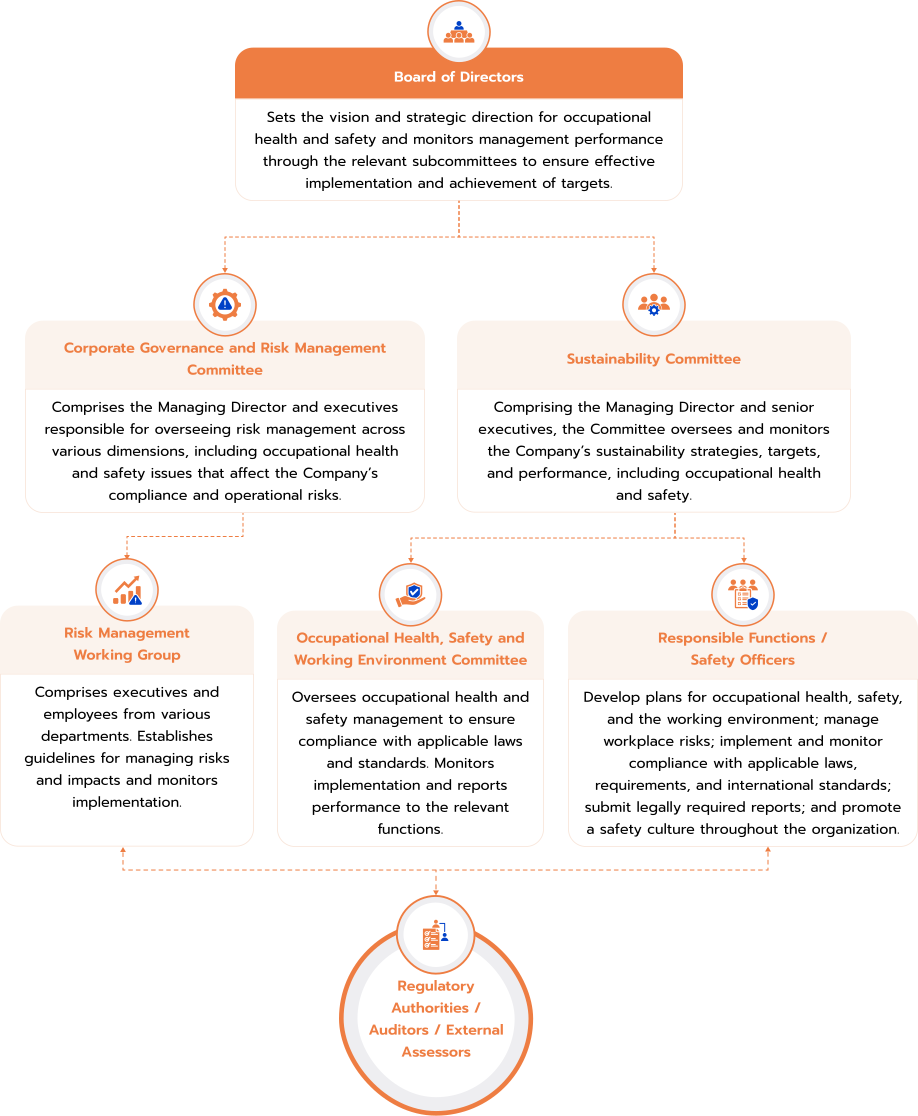
The Company places great importance on occupational health, safety, and the working environment. Performance is reported to the Board of Directors through the Sustainability Committee, which oversees and monitors the Company's sustainability strategies, targets, and performance, including occupational health and safety.
In addition, the Company has established the Occupational Health, Safety and Working Environment Committee (Safety Committee), chaired by a representative of senior management, to oversee and manage occupational health and safety risks associated with both future business activities or projects, such as power plant expansion projects, and existing operations. The Committee is also responsible for continuously monitoring and evaluating performance. The governance structure is as follows:
Governance Structure for Safety and Occupational Health Management
Work Risk Assessment
The company conducts risk assessments for both ongoing operations or projects and newly initiated operations or projects, such as installing new machinery replacements. The risk level assessment is performed to identify potential hazards and evaluate the risks associated with various activities, work areas, and overall workplace conditions. This process involves analyzing inherent hazards at each stage of work and implementing preventive measures or solutions to mitigate workplace dangers (Job Safety Analysis). It also includes evaluating the severity and likelihood of hazards occurring. The results from assessing severity and probability are then used to determine the risk level and establish risk control measures. The goal is to reduce both the likelihood and impact of hazards from high to acceptable or minimal levels, ensuring that all workers can perform their tasks safely with the lowest possible work-related risks. All high-risk tasks, such as working at heights, confined spaces, hot work with sparks, and handling hazardous chemicals, must undergo a thorough risk assessment. Additionally, appropriate risk control measures must be defined before starting work, with continuous monitoring throughout the operation.
Risk Level Assessment for Ongoing and New Projects in 2025
| Risk Assessment | SCG | SGN | SGF |
|---|---|---|---|
| Number of Tasks Assessed for Risk | 1,410 | 122 | 108 |
| Risk Level | |||
| - High | 0 | 0 | 1 |
| - Medium | 430 | 1 | 43 |
| - Acceptable | 408 | ||
| - Minor | 572 | 121 | 64 |
| The number of measures and work procedures implemented for risk control. | 809 | 27 | 29 |
Workplace Safety Measures and Procedures
External Assessment and Certification of Occupational Health and Safety
The Company is committed to enhancing its occupational health and safety management in line with recognized standards to provide a safe working environment for employees and contractors. It places importance on external assessments and certification to confirm the effectiveness of its management system and uses assessment findings to drive continuous improvement.
Stakeholders Directly Impacted

Customers

Business Partners

Employees

Community and Society